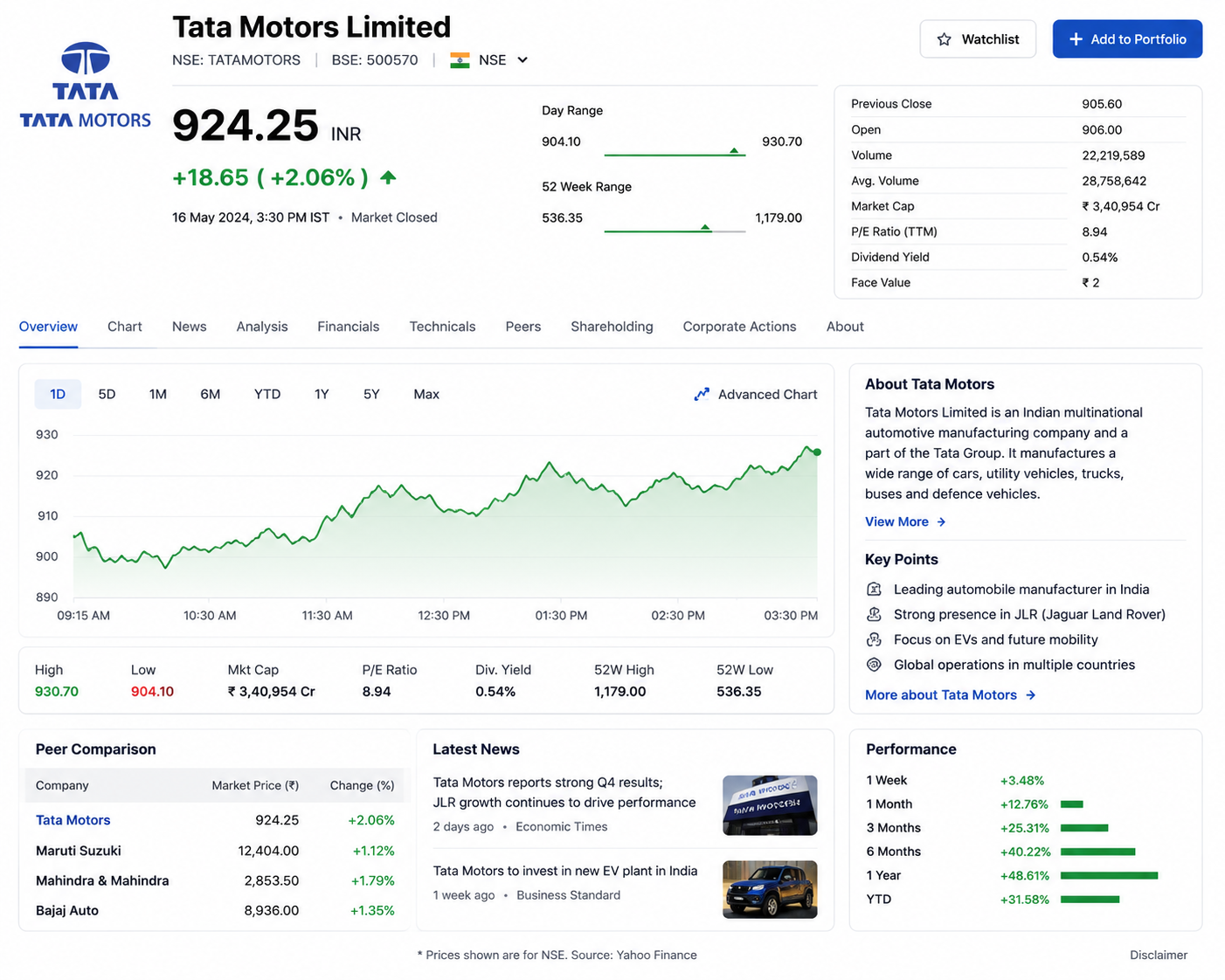
Tata Motors Share Price: Complete Analysis, Business Growth, and Future Outlook
The Tata Motors share price remains one of the most closely watched stocks in the Indian automobile sector. As part of the Tata Group, the company has transformed itself from a domestic commercial vehicle manufacturer into a global automotive leader with strong positions in passenger vehicles, electric vehicles (EVs), commercial vehicles, and luxury automobiles through Jaguar Land Rover (JLR).
Over the past few years, investors have witnessed remarkable volatility in the stock. Strong earnings, rapid EV expansion, global demand for luxury vehicles, and changing economic conditions have all influenced market sentiment.
This guide explores everything investors should know about Tata Motors, including business fundamentals, financial performance, growth opportunities, valuation, risks, and factors that influence its stock price. Whether you’re a beginner or an experienced investor, this comprehensive analysis will help you make better-informed investment decisions.
Company Overview
Tata Motors Limited is among India’s largest automobile manufacturers and operates across multiple vehicle categories.
Its business segments include:
- Passenger vehicles
- Electric vehicles
- Commercial vehicles
- Luxury vehicles through Jaguar Land Rover
- Defense mobility solutions
- Mobility and fleet solutions
The company has manufacturing facilities in India, the United Kingdom, South Korea, Thailand, and several other international markets.
Today, Tata Motors has evolved into one of India’s most innovative automotive companies, particularly in the electric mobility segment.
Why Investors Closely Watch the Stock
Several factors make Tata Motors attractive to investors.
Market Leadership
The company holds a dominant position in India’s commercial vehicle market and continues to strengthen its passenger vehicle portfolio.
Electric Vehicle Leadership
Tata Motors remains one of India’s largest electric passenger vehicle manufacturers, benefiting from increasing EV adoption and government incentives.
Global Presence
Unlike many Indian automobile companies, Tata Motors earns a significant portion of its revenue from international markets through Jaguar Land Rover.
Strong Brand Value
Being a Tata Group company adds investor confidence due to strong corporate governance and long-term business credibility.
Business Segments That Drive Revenue
Understanding where Tata Motors earns its revenue helps explain movements in its stock price.
Commercial Vehicles
Commercial vehicles remain one of the company’s biggest revenue contributors.
The segment includes:
- Heavy trucks
- Medium commercial vehicles
- Light commercial vehicles
- Buses
- Defense vehicles
Infrastructure development, logistics growth, and industrial expansion directly affect demand.
Passenger Vehicles
The passenger vehicle business has grown significantly over recent years.
Popular models include:
- Nexon
- Punch
- Harrier
- Safari
- Tiago
- Altroz
- Curvv
Strong sales volumes in this division positively influence investor sentiment.
Electric Vehicles
Electric mobility has become a major growth engine.
Popular EVs include:
- Nexon EV
- Tiago EV
- Punch EV
- Tigor EV
- Curvv EV
Increasing charging infrastructure and government support continue to strengthen this business.
Jaguar Land Rover (JLR)
Jaguar Land Rover contributes a substantial share of overall revenue.
The luxury vehicle business benefits from:
- Premium SUV demand
- Strong North American sales
- European market recovery
- Luxury electric vehicle expansion
Strong JLR performance often leads to positive momentum in Tata Motors shares.
Factors That Influence Tata Motors Share Price
Many variables determine stock movement.
Quarterly Results
Strong earnings typically improve investor confidence.
Key metrics include:
- Revenue growth
- Net profit
- EBITDA margin
- Cash flow
- Operating margin
Positive quarterly surprises often support stock appreciation.
Jaguar Land Rover Performance
Because JLR contributes significantly to profits, investors monitor:
- Vehicle sales
- Order book
- Production levels
- Semiconductor availability
- Luxury market demand
Weak JLR performance can negatively affect the stock.
Electric Vehicle Growth
Investors closely track:
- EV sales growth
- Market share
- New product launches
- Charging ecosystem
- Battery technology
Continued leadership in EVs remains an important long-term growth catalyst.
Economic Conditions
Automobile demand depends on:
- GDP growth
- Consumer spending
- Interest rates
- Inflation
- Fuel prices
A healthy economy generally supports vehicle sales.
Commodity Prices
Steel, aluminum, copper, rubber, and lithium prices directly impact manufacturing costs.
Lower raw material costs often improve profit margins.
Government Policies
Policies related to:
- EV subsidies
- Vehicle scrappage
- Emission norms
- Infrastructure spending
- Import duties
can significantly affect future growth.
Financial Performance Analysis
Financial strength plays an important role in long-term stock performance.
Important financial indicators include:
Revenue Growth
Consistent revenue growth indicates expanding demand across multiple business segments.
Diversification also helps reduce dependence on any single market.
Profitability
Improving operating margins generally indicate better cost management.
Analysts also evaluate:
- Gross margin
- EBITDA margin
- Net margin
- Return on equity
- Return on capital employed
Debt Reduction
Tata Motors has focused on reducing debt over recent years.
Lower debt results in:
- Reduced interest expenses
- Better cash flow
- Improved profitability
- Higher financial flexibility
Debt reduction has been a positive signal for investors.
Free Cash Flow
Healthy cash generation allows the company to invest in:
- New factories
- Research
- Electric vehicles
- Battery technology
- Product development
Positive free cash flow often supports higher valuations.
How Electric Vehicles Are Transforming the Business
Electric mobility is perhaps the biggest long-term opportunity.
India’s EV market continues to expand rapidly due to:
- Rising fuel prices
- Government incentives
- Improved battery technology
- Better charging infrastructure
- Growing environmental awareness
Tata Motors has established an early leadership position, giving it a competitive advantage.
The company continues investing heavily in:
- Battery manufacturing
- Software integration
- Connected vehicles
- Charging partnerships
- Future EV platforms
Many analysts believe EV growth could remain a major driver of long-term earnings.
Jaguar Land Rover’s Role in Future Growth
JLR has undergone significant transformation.
Recent strategic initiatives include:
Premium Positioning
The company has shifted toward higher-margin luxury models.
Electrification
Jaguar Land Rover is investing billions into electric luxury vehicles.
Improved Profitability
Cost optimization has helped improve operating margins.
Strong Global Demand
Luxury SUVs continue experiencing healthy demand across key international markets.
Stable JLR performance provides additional diversification for Tata Motors.
Competitive Landscape
The Indian automotive industry remains highly competitive.
Major competitors include:
| Company | Key Strength |
|---|---|
| Maruti Suzuki | Passenger cars |
| Mahindra & Mahindra | SUVs and tractors |
| Hyundai Motor India | Passenger vehicles |
| Ashok Leyland | Commercial vehicles |
| Toyota Kirloskar | Premium passenger vehicles |
| Kia India | SUVs and compact cars |
Tata Motors competes across multiple vehicle categories, providing revenue diversification.
Strengths of Tata Motors
Several factors support long-term growth.
Diversified Business
Revenue comes from multiple vehicle categories rather than relying on one segment.
Strong EV Portfolio
The company enjoys first-mover advantages in India’s EV market.
Global Operations
International diversification reduces dependence on domestic demand.
Research and Development
Continuous innovation strengthens future competitiveness.
Brand Reputation
The Tata Group enjoys strong trust among customers and investors.
Risks Investors Should Consider
Every investment carries risks.
Important challenges include:
Global Slowdown
Economic weakness may reduce automobile demand.
Competition
Both domestic and international automakers continue expanding their product offerings.
Commodity Inflation
Higher raw material prices can reduce profitability.
Currency Fluctuations
International operations expose the company to exchange rate risks.
Technology Changes
Rapid innovation requires continuous investment in research and product development.
Valuation Factors Investors Monitor
Rather than focusing only on daily price movement, investors often evaluate valuation metrics.
Common measures include:
- Price-to-Earnings (P/E)
- Price-to-Book (P/B)
- EV/EBITDA
- Earnings growth
- Free cash flow
- Return on equity
Comparing these metrics with industry peers helps determine whether the stock appears attractively valued.
Dividend Policy
Historically, Tata Motors has prioritized business expansion and investment over large dividend payouts.
Capital allocation often focuses on:
- Debt reduction
- EV investments
- Manufacturing capacity
- Technology development
- Product launches
Long-term investors generally pay greater attention to earnings growth than dividend yield.
Should Long-Term Investors Consider Tata Motors?
Investment decisions depend on financial goals and risk tolerance.
Reasons some investors favor Tata Motors include:
- Leadership in commercial vehicles
- Strong passenger vehicle growth
- EV expansion
- Global diversification
- Improving profitability
- Ongoing debt reduction
- Strong parent group
However, investors should also consider market cycles and industry risks before making investment decisions.
Tips Before Investing
Consider following these best practices:
- Study annual reports.
- Review quarterly earnings.
- Monitor industry trends.
- Track EV adoption.
- Compare valuations with competitors.
- Diversify your investment portfolio.
- Invest with a long-term perspective rather than reacting to short-term market volatility.
Future Outlook
The long-term outlook for Tata Motors appears closely tied to several structural growth themes.
These include:
- Increasing vehicle ownership in India
- Rapid EV adoption
- Infrastructure expansion
- Premium luxury vehicle demand
- Digital vehicle technologies
- Autonomous driving innovations
- Battery manufacturing improvements
If the company continues executing its growth strategy while maintaining profitability and financial discipline, it may remain an important player in both Indian and global automotive markets.
Investors should continue monitoring earnings growth, product launches, EV adoption, JLR performance, and macroeconomic developments that influence automobile demand.
Frequently Asked Questions
Is Tata Motors a good long-term investment?
Many long-term investors view Tata Motors as a strong automotive company due to its diversified business, EV leadership, commercial vehicle dominance, and global presence. However, every investment should align with individual financial goals and risk tolerance.
Why does Tata Motors share price fluctuate frequently?
The stock is influenced by quarterly earnings, Jaguar Land Rover performance, EV sales, commodity prices, interest rates, global economic conditions, investor sentiment, and overall stock market trends.
What role does Jaguar Land Rover play in Tata Motors?
Jaguar Land Rover contributes a significant portion of revenue and profitability. Strong luxury vehicle demand often has a positive impact on the company’s overall financial performance.
How important is the EV business for Tata Motors?
The electric vehicle business has become one of the company’s most important long-term growth drivers. Continued investment in EV technology, battery innovation, and charging infrastructure strengthens its future growth potential.
What factors should investors monitor before buying Tata Motors shares?
Investors should review revenue growth, profitability, debt levels, cash flow, EV market expansion, JLR performance, valuation metrics, industry competition, and broader economic conditions before making investment decisions.
Conclusion
The Tata Motors share price reflects much more than daily market fluctuations. It represents investor confidence in one of India’s largest automotive companies as it navigates a rapidly changing industry driven by electrification, digital technology, premium mobility, and global expansion.
With leadership in commercial vehicles, a growing passenger vehicle portfolio, strong electric vehicle capabilities, and the international presence of Jaguar Land Rover, Tata Motors has built multiple avenues for long-term growth. While challenges such as economic cycles, competition, and raw material costs remain, the company’s continued focus on innovation, operational efficiency, and financial discipline positions it well for the future.
For investors seeking exposure to India’s evolving automobile industry, Tata Motors remains a company worth studying carefully through regular financial analysis, valuation assessments, and long-term business performance rather than short-term market movements.