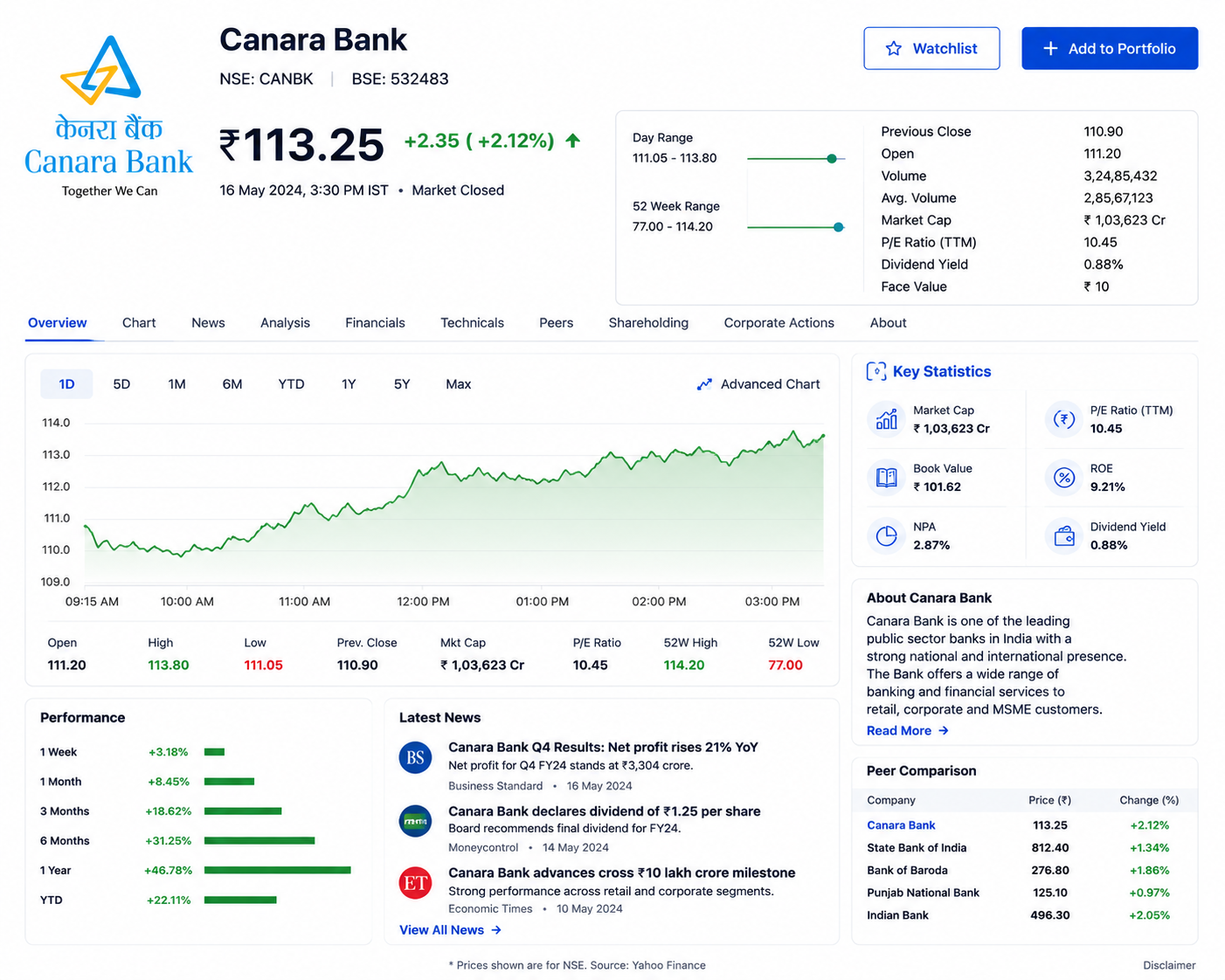
Canara Bank Share Price: Latest Analysis, History, Growth Potential, and Future Outlook
Investors searching for the Canara Bank share price often want more than today’s stock value. They want to understand why the price moves, whether the stock is fundamentally strong, how it compares with competitors, and if it has the potential to generate long-term returns.
Canara Bank has transformed significantly over the past few years. Better asset quality, improving profitability, digital banking expansion, and steady loan growth have strengthened investor confidence. As one of India’s largest public sector banks, it continues to play a vital role in the country’s financial system while attracting both retail and institutional investors.
This guide explains everything you need to know, including historical performance, financial health, valuation metrics, growth opportunities, risks, dividend history, and what investors should watch before making an investment decision.
Canara Bank at a Glance
| Particular | Details |
|---|---|
| Founded | 1906 |
| Headquarters | Bengaluru, India |
| Sector | Banking |
| Industry | Public Sector Banking |
| Listed On | NSE, BSE |
| Ownership | Government of India (Major Stakeholder) |
| Business | Retail, Corporate, MSME, Agriculture, Digital Banking |
Canara Bank is among India’s oldest and most respected public sector banks. With thousands of branches and ATMs nationwide, it serves millions of customers across retail and corporate banking segments.
Why Investors Track Canara Bank Stock
The bank has become a popular investment because of several positive factors:
- Strong quarterly earnings
- Rising profitability
- Improving return on equity
- Declining bad loans
- Healthy credit growth
- Attractive dividend payouts
- Government support
- Reasonable valuation compared to private banks
Public sector banking stocks have witnessed renewed interest as financial performance across the sector has improved considerably.
Historical Performance
The stock has experienced different phases throughout its history.
Early Years
Like many PSU banks, Canara Bank traded within a narrow range for several years due to:
- High non-performing assets (NPAs)
- Slow credit growth
- Lower profitability
- Weak investor sentiment
Recovery Phase
The banking sector began recovering after multiple structural reforms, including:
- Better loan recovery
- Insolvency and Bankruptcy Code implementation
- Improved capital adequacy
- Government recapitalization
- Stronger corporate balance sheets
These developments significantly improved investor confidence.
Recent Growth
Recent years have seen substantial improvements in:
- Net profit
- Asset quality
- Loan growth
- CASA ratio
- Return ratios
These improvements have supported a stronger stock price trend.
Factors That Influence the Share Price
Several internal and external factors impact stock performance.
Quarterly Financial Results
Investors closely monitor every quarterly earnings report.
Important metrics include:
- Net profit
- Net interest income (NII)
- Net interest margin (NIM)
- Operating profit
- Earnings per share
- Cost-to-income ratio
Better-than-expected results often boost investor confidence.
Asset Quality
Asset quality remains one of the biggest indicators for any bank.
Key measures include:
- Gross NPA
- Net NPA
- Provision Coverage Ratio
Lower NPAs generally indicate better financial health.
Loan Growth
Consistent loan growth demonstrates expanding business operations.
Major lending segments include:
- Home loans
- Personal loans
- Vehicle finance
- MSME loans
- Corporate lending
- Agriculture finance
Balanced growth across these segments supports long-term profitability.
Interest Rate Cycle
Changes in RBI monetary policy directly influence banks.
Higher interest rates may improve lending margins, while lower rates can stimulate credit demand.
Investors therefore closely monitor RBI policy announcements.
Economic Growth
Banking stocks generally perform well when the economy expands.
Higher GDP growth leads to:
- Increased borrowing
- Better loan repayments
- Improved corporate earnings
- Higher consumer spending
These factors support stronger banking performance.
Financial Performance Analysis
Canara Bank has shown significant improvement across major financial indicators.
Revenue Growth
The bank has consistently expanded its revenue through:
- Growing loan book
- Improved treasury operations
- Higher fee income
- Better interest earnings
Profitability
Profitability has improved due to:
- Reduced provisioning
- Better cost management
- Strong credit demand
- Improved recovery of stressed assets
Higher profitability strengthens investor confidence.
Return on Equity
Return on Equity (ROE) measures how efficiently management generates returns for shareholders.
A rising ROE typically signals improving operational efficiency.
Capital Adequacy
Banks require adequate capital to absorb future risks.
Canara Bank maintains regulatory capital requirements while supporting business expansion.
Asset Quality Improvements
Asset quality has become one of the biggest success stories.
Several developments have contributed:
- Faster recovery of bad loans
- Improved credit monitoring
- Better underwriting standards
- Lower slippages
- Strong provisioning
Lower NPAs improve both profitability and valuation.
Digital Banking Transformation
Technology has become a major growth driver.
The bank has invested heavily in:
- Mobile banking
- Internet banking
- Digital loan processing
- AI-based customer services
- Online account opening
- UPI services
- Digital payments
Digital transformation helps reduce operational costs while improving customer experience.
Business Segments
Revenue comes from multiple business verticals.
Retail Banking
Products include:
- Savings accounts
- Current accounts
- Home loans
- Personal loans
- Gold loans
- Education loans
Retail banking provides stable long-term income.
Corporate Banking
Corporate services include:
- Working capital finance
- Infrastructure loans
- Project finance
- Trade finance
- Cash management
Corporate banking contributes significantly to loan growth.
MSME Banking
Small and medium businesses continue to be an important customer segment.
Government support for MSMEs creates additional lending opportunities.
Agriculture Banking
As a public sector bank, Canara Bank maintains a strong presence in rural and agricultural financing.
Dividend History
Dividend-paying stocks attract income-focused investors.
Canara Bank has rewarded shareholders through periodic dividend distributions, depending on profitability and regulatory approvals.
Dividend investing offers:
- Passive income
- Long-term wealth creation
- Portfolio stability
However, dividend payments may vary based on annual earnings.
Valuation Analysis
Investors should evaluate more than just the stock price.
Important valuation metrics include:
- Price-to-Earnings (P/E)
- Price-to-Book (P/B)
- Dividend Yield
- Return on Assets
- Return on Equity
- Book Value per Share
Public sector banks often trade at lower valuations compared to private banks despite improving fundamentals.
Growth Drivers
Several long-term factors could support future growth.
Expanding Credit Demand
India’s growing economy continues increasing demand for:
- Housing loans
- Consumer finance
- Business loans
- Infrastructure funding
Banks benefit directly from this expansion.
Government Infrastructure Spending
Large infrastructure investments require substantial banking support.
Public sector banks often play a major financing role.
Rising Financial Inclusion
Millions of Indians continue entering the formal banking system.
Financial inclusion creates opportunities for:
- Deposits
- Loans
- Insurance
- Digital banking
- Investment products
Digital Banking Adoption
Digital services continue reducing operating costs while improving customer convenience.
Higher digital transactions can improve efficiency over time.
Strong Deposit Franchise
Stable deposits provide low-cost funding for lending operations.
Growing CASA deposits improve profitability by lowering funding costs.
Risks Investors Should Consider
Every investment carries risks.
Economic Slowdown
Slower economic growth can reduce:
- Loan demand
- Corporate earnings
- Consumer spending
This may affect banking profitability.
Rising NPAs
Unexpected loan defaults remain one of the biggest risks for banks.
Higher NPAs increase provisioning expenses and reduce profits.
Interest Rate Volatility
Rapid interest rate changes can influence lending margins.
Banks must carefully manage interest rate risk.
Regulatory Changes
RBI regulations may affect:
- Capital requirements
- Lending norms
- Provisioning standards
- Liquidity requirements
Regulatory changes sometimes impact profitability.
Market Volatility
Short-term stock price movements often reflect market sentiment rather than business fundamentals.
Long-term investors usually focus more on business performance than daily price fluctuations.
Comparison with Other PSU Banks
| Feature | Canara Bank | SBI | Bank of Baroda | Punjab National Bank |
|---|---|---|---|---|
| Branch Network | Extensive | Largest | Strong | Large |
| Digital Banking | Strong | Very Strong | Strong | Improving |
| Asset Quality | Improved | Strong | Improved | Improving |
| Profitability | Rising | Strong | Strong | Recovering |
| Dividend Potential | Good | Good | Good | Moderate |
Each bank has its strengths, but Canara Bank has become increasingly attractive due to its improving financial performance.
Is Canara Bank a Good Long-Term Investment?
Many investors consider Canara Bank suitable for long-term investing because of:
- Consistent profit growth
- Improved asset quality
- Attractive valuation
- Government ownership
- Strong nationwide presence
- Growing digital banking capabilities
- Better operational efficiency
However, investors should align any investment with their financial goals, risk tolerance, and portfolio diversification strategy.
Tips Before Investing
Before purchasing banking stocks, consider the following checklist:
- Study quarterly financial results.
- Compare valuation with peers.
- Monitor RBI policy decisions.
- Review NPA trends.
- Analyze loan growth.
- Evaluate dividend history.
- Assess overall market conditions.
- Avoid investing solely based on short-term price movements.
Fundamental analysis remains more reliable than following market rumors.
What Could Influence Future Performance?
Several developments may shape future stock performance.
Positive factors include:
- Faster economic growth
- Continued loan expansion
- Lower NPAs
- Higher digital adoption
- Better profitability
- Stable interest margins
- Increased retail lending
Potential challenges include:
- Global economic uncertainty
- Inflation
- Credit defaults
- Regulatory tightening
- Market corrections
Monitoring these factors can help investors make informed decisions.
Common Mistakes Investors Should Avoid
Many beginners make avoidable mistakes while investing in banking stocks.
These include:
- Buying solely because prices have recently risen.
- Ignoring financial statements.
- Focusing only on short-term gains.
- Not diversifying investments.
- Reacting emotionally during market volatility.
- Following unverified stock tips.
Successful investing requires patience, research, and disciplined decision-making.
Frequently Asked Questions
Is Canara Bank a good stock for long-term investment?
Many investors view Canara Bank as a promising long-term investment because of improving profitability, stronger asset quality, digital expansion, and attractive valuation. Investors should still conduct their own research before investing.
Why does the share price change every day?
Daily movements occur due to investor demand and supply, quarterly earnings, economic news, RBI policies, interest rates, global markets, and overall market sentiment.
Does Canara Bank pay dividends?
Yes. Canara Bank has a history of paying dividends when profitability and regulatory conditions permit. Dividend amounts may vary each year.
Which financial indicators should investors monitor?
Key indicators include net profit, Net Interest Margin (NIM), Gross NPA, Net NPA, Return on Equity (ROE), Price-to-Book ratio, loan growth, and capital adequacy.
What are the biggest risks of investing in Canara Bank?
Major risks include rising bad loans, economic slowdowns, regulatory changes, market volatility, and fluctuations in interest rates that may affect banking profitability.
Conclusion
The Canara Bank share price reflects much more than daily market fluctuations. It represents investor expectations regarding profitability, loan growth, asset quality, digital transformation, and the broader outlook for India’s banking sector.
Canara Bank has undergone a notable transformation in recent years. Stronger financial performance, healthier balance sheets, improved risk management, and expanding digital capabilities have strengthened its position among India’s leading public sector banks. While no stock is free from risk, the bank’s improving fundamentals and long operating history make it a company worth watching for investors seeking exposure to India’s financial sector.
Rather than focusing only on short-term price movements, successful investors should regularly review earnings, valuation, economic trends, and business performance before making investment decisions. A disciplined, research-driven approach remains the best strategy for building long-term wealth through banking stocks.