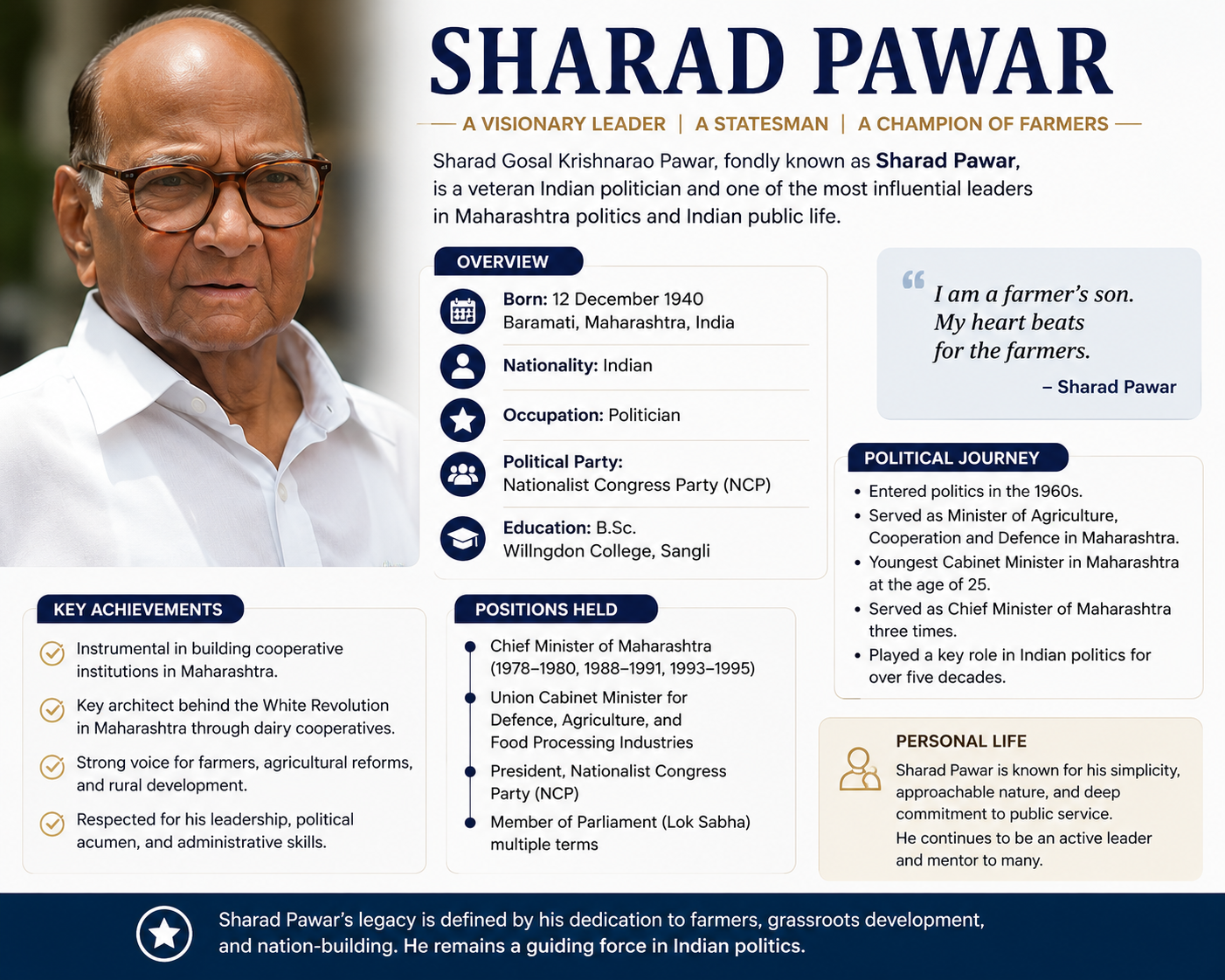
Sharad Pawar: Biography, Political Career, Achievements, Legacy, and Influence in Indian Politics
Sharad Pawar is one of India’s most experienced and influential political leaders. With a career spanning more than five decades, he has played a significant role in shaping Maharashtra’s politics and has held several important positions in the Government of India. Known for his strategic political skills, administrative experience, and ability to build alliances, Pawar has remained a key figure in Indian politics through changing political landscapes.
From serving multiple terms as the Chief Minister of Maharashtra to leading the Ministry of Agriculture at the national level, Sharad Pawar has left a lasting mark on governance, agriculture, sports administration, and coalition politics. His journey reflects resilience, adaptability, and a deep understanding of India’s political system.
This comprehensive guide explores Sharad Pawar’s life, political career, achievements, leadership style, challenges, and legacy.
Early Life and Education
Sharad Govindrao Pawar was born on December 12, 1940, in Baramati, Pune district, Maharashtra. He grew up in a family that valued education and public service.
His father, Govindrao Pawar, was actively involved in cooperative institutions and local administration, while his mother, Shardabai Pawar, encouraged education and social responsibility among her children.
Pawar completed his early education in Baramati before attending Brihan Maharashtra College of Commerce (BMCC) in Pune. During his college years, he became interested in student politics and public affairs, laying the foundation for his future political career.
Entry Into Politics
Sharad Pawar entered active politics at a young age and quickly gained recognition for his organizational skills.
His early political journey included:
- Participation in youth political movements
- Work with cooperative organizations
- Building grassroots support across Maharashtra
- Active involvement in the Indian National Congress
In 1967, he was elected to the Maharashtra Legislative Assembly for the first time, marking the beginning of a long legislative career.
Rise in Maharashtra Politics
Pawar emerged as one of Maharashtra’s most prominent leaders during the 1970s.
His political strengths included:
- Strong grassroots connections
- Administrative efficiency
- Coalition management
- Rural development initiatives
- Focus on agriculture and cooperatives
His growing popularity eventually led to his appointment as the Chief Minister of Maharashtra.
Terms as Chief Minister of Maharashtra
Sharad Pawar served as the Chief Minister of Maharashtra on multiple occasions.
| Term | Years |
|---|---|
| First Term | 1978–1980 |
| Second Term | 1988–1991 |
| Third Term | 1993–1995 |
| Fourth Term | Brief tenure in 1993 after returning to state politics |
During his tenure, the government focused on:
- Industrial development
- Infrastructure expansion
- Agricultural growth
- Urban planning
- Rural welfare
- Disaster management
His administration also dealt with significant challenges, including the aftermath of the 1993 Mumbai bomb blasts and the Latur earthquake.
Formation of the Nationalist Congress Party (NCP)
One of the most significant moments in Sharad Pawar’s political career came in 1999.
Along with P. A. Sangma and Tariq Anwar, he raised concerns regarding foreign-born leadership in the Congress Party.
This disagreement eventually led to the formation of the Nationalist Congress Party (NCP).
The new party became a major political force in Maharashtra and later participated in coalition governments at both the state and national levels.
Role in National Politics
Sharad Pawar has served in several important positions in the Union Government.
His key responsibilities included:
- Minister of Defence (1991–1993)
- Minister of Agriculture (2004–2014)
- Minister of Consumer Affairs, Food and Public Distribution
- Member of Parliament in both Lok Sabha and Rajya Sabha at different times
His national leadership expanded his influence beyond Maharashtra.
Contributions as Agriculture Minister
Pawar’s tenure as Union Agriculture Minister lasted nearly a decade.
During this period, attention was given to:
Agricultural Production
Policies encouraged increased food grain production and modernization of farming practices.
Food Security
The government worked toward improving food availability and strengthening procurement systems.
Irrigation and Rural Development
Several initiatives aimed to improve irrigation infrastructure and support farmers.
Horticulture
Greater emphasis was placed on fruits, vegetables, and commercial crops to diversify agricultural income.
Leadership in Cooperative Institutions
Sharad Pawar has long been associated with Maharashtra’s cooperative movement.
His work involved:
- Sugar cooperatives
- Dairy cooperatives
- Agricultural credit institutions
- Rural banking initiatives
The cooperative sector played a major role in the state’s rural economy and political landscape.
Role in Sports Administration
Apart from politics, Pawar has held leadership positions in sports organizations.
His contributions include involvement with:
- Cricket administration
- Sports promotion
- Infrastructure development for sporting events
He served as the president of the Board of Control for Cricket in India (BCCI) and later chaired the International Cricket Council (ICC).
Political Ideology
Sharad Pawar is often associated with:
- Secular politics
- Federalism
- Coalition governance
- Agricultural development
- Rural empowerment
- Economic development
- Pragmatic decision-making
His ability to work with leaders from different political parties has been considered one of his defining political characteristics.
Major Achievements
Throughout his political journey, Sharad Pawar has accumulated several notable achievements.
Long Political Career
Few Indian politicians have remained politically relevant for more than five decades.
Coalition Builder
Pawar has earned recognition for negotiating alliances and maintaining coalition governments.
Agricultural Focus
His work in agriculture influenced policy discussions on food production and rural development.
Administrative Experience
Serving in both state and central governments provided him with extensive governance experience.
Regional Development
Baramati became widely recognized as a model for agricultural and industrial development during his political career.
Challenges and Controversies
Like many senior political leaders, Sharad Pawar’s career has also included criticism and controversy.
Issues that have attracted public debate include:
- Agricultural policy decisions
- Coalition politics
- Internal party disagreements
- Corruption allegations involving political associates
- Political realignments
It is important to note that allegations do not necessarily establish legal wrongdoing, and public opinion on these matters remains divided.
Split Within the Nationalist Congress Party
One of the most significant developments in recent years was the split within the Nationalist Congress Party.
The division resulted in separate political factions led by different leaders within the party, leading to legal and organizational disputes over the party name and symbol.
This development reshaped Maharashtra’s political landscape and influenced coalition politics in the state.
Leadership Style
Sharad Pawar is widely regarded as a practical and experienced administrator.
His leadership style is often described as:
- Strategic
- Calm under pressure
- Consensus-oriented
- Experienced in negotiations
- Adaptable to changing political situations
These qualities have contributed to his longevity in public life.
Influence on Maharashtra Politics
Pawar’s influence extends beyond elections.
His political network has shaped:
- Cooperative institutions
- Agricultural organizations
- Local governance
- Regional leadership development
- Coalition politics
Many younger politicians have emerged under his mentorship.
Public Image
Supporters often praise Sharad Pawar for:
- Administrative experience
- Crisis management
- Political strategy
- Agricultural focus
- Long public service
Critics, however, have questioned some policy decisions, alliances, and political strategies throughout his career.
His public image reflects both admiration and political debate, a common feature for leaders with long careers in public office.
Awards and Recognition
Over the years, Sharad Pawar has received recognition for his contributions to public service, agriculture, and sports administration.
His influence has extended beyond politics into areas such as cooperative development and cricket administration.
Interesting Facts About Sharad Pawar
- He entered politics while still in his twenties.
- He has served four terms as the Chief Minister of Maharashtra.
- He held the Union Agriculture portfolio for nearly ten years.
- He played a prominent role in India’s cooperative movement.
- He served as president of the BCCI and chairman of the ICC.
- Baramati remains closely associated with his political career.
- He is considered one of India’s most experienced coalition leaders.
Frequently Asked Questions
Who is Sharad Pawar?
Sharad Pawar is a veteran Indian politician who has served as the Chief Minister of Maharashtra, Union Agriculture Minister, Defence Minister, and founder of the Nationalist Congress Party.
When was Sharad Pawar born?
He was born on December 12, 1940, in Baramati, Maharashtra.
Which political party did Sharad Pawar found?
He co-founded the Nationalist Congress Party (NCP) in 1999.
What are Sharad Pawar’s major achievements?
His major achievements include leading Maharashtra as Chief Minister, serving as Union Agriculture Minister, promoting cooperative institutions, and contributing to cricket administration.
Why is Sharad Pawar considered an influential leader?
He is regarded as influential because of his long political career, administrative experience, coalition-building skills, and significant role in Maharashtra and national politics.
Conclusion
Sharad Pawar’s political journey reflects more than five decades of public service, leadership, and influence in Indian politics. From his early years in Maharashtra’s cooperative movement to serving in key positions within the state and central governments, he has played an important role in shaping policy, governance, and coalition politics.
His supporters credit him with administrative expertise, agricultural reforms, and strategic leadership, while critics continue to debate aspects of his political decisions and alliances. Regardless of differing political perspectives, Sharad Pawar remains one of the most experienced and consequential figures in contemporary Indian politics, with a legacy that continues to influence Maharashtra and the broader national political landscape.