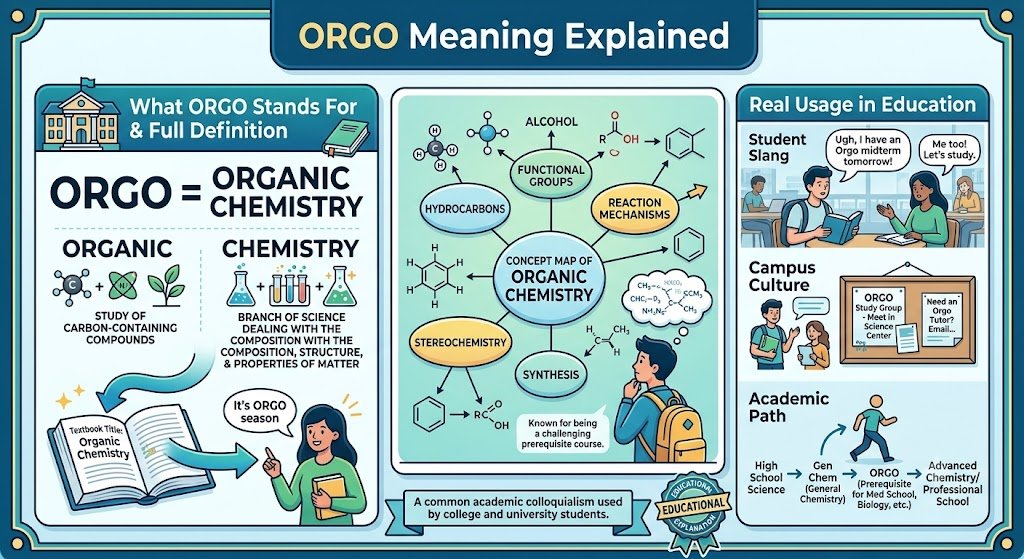
Orgo Meaning Explained: What “Orgo” Stands For, Full Definition, and Real Usage in Education
If you’ve ever heard students say “I have orgo tomorrow” or “orgo is killing me this semester,” you might have paused and wondered what they actually mean. The term “orgo” meaning is commonly searched by students, especially those entering science, medical, or pre-medical fields. Despite sounding informal, it is widely used in academic environments across colleges and universities.
In simple terms, orgo is short for organic chemistry, one of the most important and often challenging branches of chemistry. But the meaning of orgo goes beyond just a shortcut word. It reflects student culture, academic pressure, and a subject that plays a major role in medicine, pharmacy, biology, and chemical sciences.
This detailed guide breaks down the true orgo meaning, where the term comes from, how it is used, why students struggle with it, and how you can master the subject effectively. Whether you’re a beginner or just curious about the slang, this article gives you everything you need to understand it clearly.
What Is the Meaning of “Orgo”?
The word “orgo” is an informal abbreviation for:
Organic Chemistry
So when someone says “I’m studying orgo,” they simply mean:
“I am studying organic chemistry.”
Organic chemistry is the branch of science that focuses on:
- Carbon-based compounds
- Molecular structures
- Chemical reactions involving carbon
- Synthesis of organic compounds
- Reaction mechanisms
Simple Definition of Orgo Meaning
Orgo = Organic Chemistry (informal student slang)
It is not an official scientific term but a widely accepted shorthand used in academic settings.
Where Does the Term “Orgo” Come From?
The term “orgo” originated in North American college culture, especially in universities where organic chemistry is part of early science or pre-med curricula.
Students naturally shorten long subject names for convenience. Just like:
- “Bio” for Biology
- “Phys” for Physics
- “Calc” for Calculus
Similarly, organic chemistry became “orgo.”
Why the abbreviation stuck:
- Organic chemistry is a long and frequently used term
- Students needed a quick, casual reference
- It became part of campus slang
- Professors and tutors even started using it informally
Over time, “orgo” became a recognized academic shorthand in student communities worldwide.
Understanding Organic Chemistry (Orgo in Depth)
To truly understand orgo meaning, you need to understand the subject itself.
What is Organic Chemistry?
Organic chemistry is the study of carbon-containing compounds and their behavior.
Carbon is unique because it can form:
- Strong bonds with itself
- Long chains
- Rings and complex structures
This makes organic chemistry incredibly diverse and essential.
What Does Orgo Study Include?
Students studying orgo typically learn about:
1. Molecular Structure
Understanding how atoms are arranged in space.
2. Functional Groups
Groups of atoms that determine chemical behavior.
Examples:
- Alcohols (-OH)
- Aldehydes (-CHO)
- Ketones (C=O)
3. Reaction Mechanisms
Step-by-step breakdown of how reactions occur.
4. Stereochemistry
Study of 3D arrangement of molecules.
5. Organic Synthesis
Creating complex molecules from simpler ones.
Why Is Orgo Important?
Organic chemistry is the backbone of several fields:
- Medicine
- Pharmacy
- Biochemistry
- Biotechnology
- Materials science
- Food chemistry
Without orgo, modern drug development and chemical industries would not exist.
Why Is Orgo Considered Difficult?
One of the most common associations with the orgo meaning is difficulty.
Many students say orgo is one of the hardest courses in college science programs.
Main Reasons Students Struggle:
1. Memorization + Understanding Combination
It’s not just memorizing facts you must understand reaction logic.
2. Complex Reaction Mechanisms
Multi-step processes require deep analytical thinking.
3. Time Pressure
Courses move quickly with heavy workloads.
4. Abstract Concepts
Molecular structures are invisible and require visualization skills.
5. Cumulative Learning
Each topic builds on previous ones.
Student Perspective on Orgo
Students often describe orgo as:
- “A mental workout”
- “A puzzle that never ends”
- “The toughest pre-med filter course”
However, with practice, it becomes manageable and even enjoyable for many learners.
Real-Life Usage of “Orgo”
Understanding orgo meaning also involves seeing how it is used in conversation.
Example Sentences:
- “I have an orgo exam next week.”
- “Orgo lab takes three hours every Friday.”
- “She is tutoring me in orgo.”
- “I finally passed orgo after two tries.”
In Academic Context:
- Professors may say: “Orgo I covers basic mechanisms.”
- Students: “Orgo is harder than physics this semester.”
Orgo vs Organic Chemistry: Is There a Difference?
No scientific difference exists between the two terms.
| Term | Meaning | Usage |
| Organic Chemistry | Formal academic term | Used in textbooks, exams, research |
| Orgo | Informal abbreviation | Used by students and educators casually |
So:
Orgo = informal version of Organic Chemistry
Who Uses the Term “Orgo”?
The term is widely used by:
- College students
- Pre-med students
- Chemistry majors
- Tutors and teaching assistants
- Online study communities
It is especially common in countries like:
- United States
- Canada
- India (among English-medium science students)
- UK (less common but still used informally)
Tips to Succeed in Orgo (From an Academic Perspective)
Understanding the orgo meaning is one thing succeeding in it is another.
Here are proven strategies:
1. Focus on Mechanisms, Not Memorization
Understand why reactions happen.
2. Practice Daily
Even 20–30 minutes of problem-solving helps.
3. Use Molecular Visualization Tools
Draw structures repeatedly.
4. Break Down Reactions Step-by-Step
Never try to learn everything at once.
5. Revise Regularly
Orgo is cumulative revision is key.
6. Work with Study Groups
Explaining concepts improves retention.
Common Misunderstandings About Orgo
Many beginners misunderstand what orgo actually is.
Misconception 1: It’s Just Memorization
Reality: It is logic-based problem solving.
Misconception 2: Only Chemistry Students Need It
Reality: It is essential for medicine, pharmacy, and biology.
Misconception 3: It Has No Real-Life Use
Reality: It is used in drug development, plastics, food science, and more.
Why “Orgo” Became So Popular Online
The keyword orgo meaning is also popular due to online academic communities.
Students use it frequently on:
- Reddit study forums
- Quora discussions
- YouTube study videos
- Discord academic groups
It represents shared academic struggle and identity among science students.
Orgo in Modern Education
Today, orgo is taught with more advanced tools:
- 3D molecular modeling software
- Interactive simulations
- Online lab platforms
- Video-based learning modules
These tools make it easier to understand complex reactions.
Conclusion
The orgo meaning goes far beyond just a casual abbreviation. While it simply stands for organic chemistry, it represents one of the most foundational and challenging subjects in science education. From understanding carbon-based molecules to mastering complex reaction mechanisms, orgo plays a crucial role in shaping future scientists, doctors, and researchers.
Although students often view orgo as difficult, the subject becomes far more approachable with consistent practice, conceptual understanding, and the right study strategy. Whether you are preparing for exams or just trying to understand academic slang, knowing the true meaning of orgo helps you connect better with the world of science education.
In the end, orgo is not just a subject it is a learning journey that builds analytical thinking, problem-solving skills, and scientific curiosity.
FAQ: Orgo Meaning
1. What does orgo mean in chemistry?
Orgo means organic chemistry, a branch of chemistry that studies carbon-based compounds and their reactions.
2. Is orgo a real word?
Yes, but it is informal. It is student slang for organic chemistry.
3. Why do students call it orgo?
Because it is shorter, easier to say, and widely used in college culture.
4. Is orgo hard?
Many students find it challenging due to complex mechanisms and abstract concepts, but it becomes manageable with practice.
5. Is orgo important for medical students?
Yes. It is a core subject for pre-med and medical-related fields.
6. What is the difference between orgo 1 and orgo 2?
- Orgo 1: Basics of structure, bonding, and simple reactions
- Orgo 2: Advanced reactions, synthesis, and mechanisms
7. Can I pass orgo without memorizing everything?
Yes. Understanding reaction patterns is more important than pure memorization.